To find a meeting time across time zones, write each person's ordinary working hours and convert them all to one clock, yours. If those hours overlap, book inside the overlap. If they don't, which happens once a team spans enough zones, pick a time that asks someone to start early or stay late, and skip any time that falls between midnight and 05:00 for someone. Then check the date. A late meeting for you can already be the next morning for them.
Step 1: Put everyone on your clock
Write each person's ordinary hours, then convert them using the date of the meeting. Daylight saving time moves the gaps, and not every place changes its clocks (more on that below).
Take people in Vancouver, Toronto, London and Shanghai, each working about 09:00 to 18:00 local time, on a weekday in late November. In Toronto time:
| Person | Their 09:00–18:00, in Toronto time |
|---|---|
| Vancouver | 11:00–20:00 |
| Toronto | 09:00–18:00 |
| London | 04:00–13:00 |
| Shanghai | 20:00–05:00 the next day |
Vancouver and Toronto share 11:00 to 18:00. London and Toronto share 09:00 to 13:00. Shanghai's working day starts at 20:00 Toronto time, which is when Vancouver's day ends, so Shanghai does not share an hour with anyone else in this table.
Since British Columbia stopped changing clocks, Vancouver is 3 hours behind Toronto in summer and 2 hours behind in winter. This table is the winter gap. On 1 November 2026 British Columbia stayed on Pacific time, UTC−7, while most of Ontario went back to Eastern Standard Time, UTC−5. In summer Ontario is on UTC−4 and British Columbia stays on UTC−7, so the same two cities are 3 hours apart and the Vancouver row would run 12:00–21:00 Toronto time again.
Step 2: Look for the overlap, then widen it
With two or three time zones there is usually an overlap. Book inside it, closer to the middle than to the edge.
When there isn't one, widen the window a little. Most people will take a call at 08:00, or until 20:00 or 21:00, if it is occasional. Avoid a call between midnight and 05:00 their time.
For the late-November team above, here is what a few Toronto times mean for everyone else:
| Toronto | Vancouver | London | Shanghai |
|---|---|---|---|
| 08:00 | 06:00 | 13:00 | 21:00 |
| 09:00 | 07:00 | 14:00 | 22:00 |
| 19:00 | 17:00 | 00:00 | 08:00 |
| 20:00 | 18:00 | 01:00 | 09:00 |
At 08:00 or 09:00 in Toronto, London is in the afternoon and Shanghai is in the evening. Vancouver is at 06:00 or 07:00, which is earlier than the 08:00 many people will accept, and it is still outside the middle of the night. At 19:00 or 20:00, Shanghai is at the start of the day and London is at midnight or just after. For this team, a morning in Toronto keeps everyone out of the hours between midnight and 05:00, and Vancouver is the person who starts early. If the meeting repeats, move that early hour around the group.
Step 3: See which day it is for each person
At 20:00 in Toronto on a Friday it is already Saturday morning in Shanghai. A meeting that looks like the end of your week can be the start of someone else's weekend, or the other way round.
A public holiday works differently from the hour. The holiday is an all-day date where that person lives. It will not appear on your own calendar unless you added it, so it is easy to book over. The hour conversion will not move it onto a different date.
Step 4: Watch who still changes the clocks
Not everyone changes their clocks, and the places that do don't all pick the same weekend.
Most of the United States, and most of Ontario, still move forward on the second Sunday of March and back on the first Sunday of November. British Columbia, Alberta and Manitoba no longer fall back. Saskatchewan and Yukon don't change clocks. The UK and the EU move on the last Sunday of March and the last Sunday of October. China doesn't change at all.
For two or three weeks each spring, and about a week each autumn, Toronto and London are four hours apart instead of five. A weekly meeting that was fine can land an hour off. Check the gaps again in March and in late October, or use a tool that reads each city's time zone on the date of the meeting. The Vancouver–Toronto gap is the one in the first step: 2 hours in winter, 3 in summer.
Step 5: Send the invitation with every local time
When you send the invitation, write the time for each person, not only yours. "Tuesday 08:00 Toronto, 06:00 Vancouver, 13:00 London, 21:00 Shanghai" saves everyone the conversion, and a wrong hour is visible before anyone accepts.
What Bridge shows when you look for a time
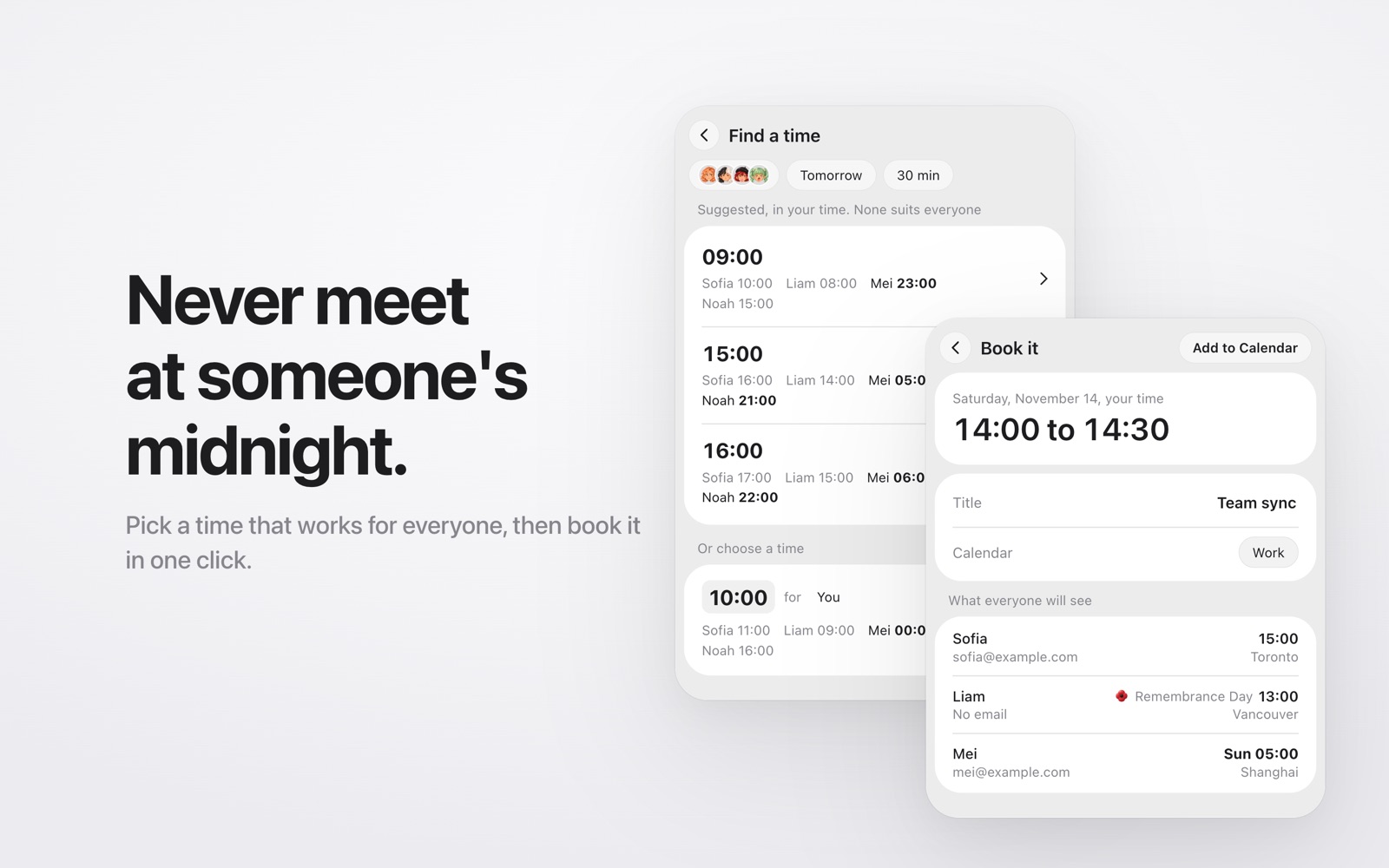
Bridge is the menu bar app we make for this. Find a time asks who is in the meeting, which day, and how long, and it checks each person's hours. We show the suggestion in your time zone with their local time underneath, so the person who would start early or stay late is named on the suggestion. Anyone who would be early, late, or up at night is marked, and the weekday is added when their date is not yours. It skips the middle of the night for everyone. When no time suits everyone, the page says so. You can also type a time of your own and see what it means for each person. Choose one and it goes into your calendar, with each person's local time written out.
Find a time does not know who is busy, and it does not skip public holidays. Those show as a tag on the person's card in the main panel, which is where you see them before you book. The ruler on that panel is the quick version: drag along it to see what time it will be for everyone when it is 21:00 for you.
The download on the Mac App Store is free. The app works for 3 days. After that, Unlock Bridge is a single payment of $9.99 in the US. It isn't a subscription. If you bought Bridge before version 1.2.0, it is already unlocked.
Questions about finding a meeting time
What's the best time for a meeting across US and European time zones? Late morning on the US East Coast, which is afternoon in the UK and western Europe. The US West Coast is early that same hour, so check it before you send the invite. In winter, Vancouver is 2 hours behind Toronto.
What if there's no overlap at all? Split the meeting into two, or rotate it so the early or late hour moves between people. The same person should not take every late call.
Should I book in my time zone or theirs? Book it in your calendar as usual and let the calendar convert. In the invitation, write each person's local time as well.
Does Bridge know when my coworkers are busy? No. It knows the time where each person lives, and the public holidays for that place. It does not see their calendars. The suggestions are ordinary hours, and you check the rest.